
03 of 06 · Learning system
Helping complete beginners learn Japanese writing.
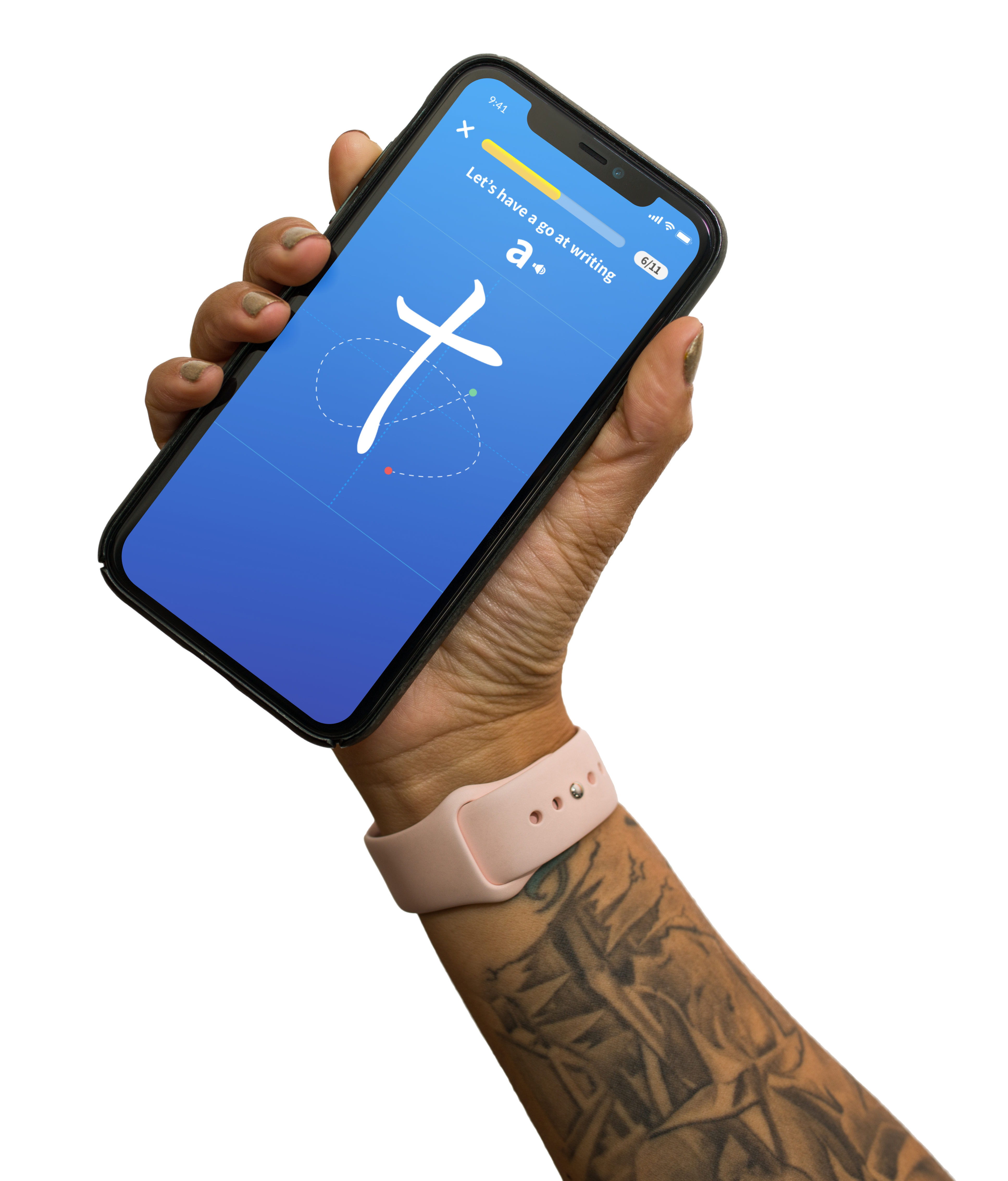
I challenged the proposed advanced-content roadmap and designed a progressive system for learning hiragana and katakana.
At a glance
- Problem
- The proposed roadmap focused on more intermediate and advanced lessons, while most of the audience remained novice or beginner.
- Key insight
- Learners repeatedly described Japanese writing as difficult to learn online and valued tracing, repetition and structured character practice.
- Decision
- Prioritise Hiragana and Katakana foundations before expanding advanced content, using progressive guidance from tracing to independent recall.
- Result
- The writing experience achieved an NPS of 62 in testing, with strong character recall during the final quiz.
01 Strategic context
Why I prioritised beginner confidence over more advanced content.
A key strategic moment in the project was challenging the initial direction from the CEO and CTO. The business wanted to add more intermediate and expert-level lessons to increase revenue and reduce churn. But research suggested that our strongest opportunity was not simply adding more content.
The CEO and CTO proposed adding more intermediate and advanced content. The majority of the audience remained novice or beginner. I recommended strengthening foundations through Hiragana and Katakana before expanding advanced lessons.

Decision and trade-off
- Alternative
- Expand intermediate and advanced lesson content as proposed by leadership.
- Chosen direction
- Prioritise Hiragana and Katakana foundations for the novice majority.
- Evidence or constraint
- Customer research showed writing was fragmented online; most learners remained beginner level.
- Consequence
- A structured beginner path from tracing to recall before harder lesson progression.
02 Customer research
Why writing mattered to learners.
During testing and interviews, learners repeatedly described Japanese writing as difficult to learn online. Available tools felt fragmented, hard to follow or disconnected from speaking practice.
For many beginners, learning characters made progress feel tangible and helped them move beyond relying entirely on romaji. They valued tracing, repetition and structured character practice — not writing as a separate academic exercise.
03 Domain research
How Japanese writing is traditionally taught
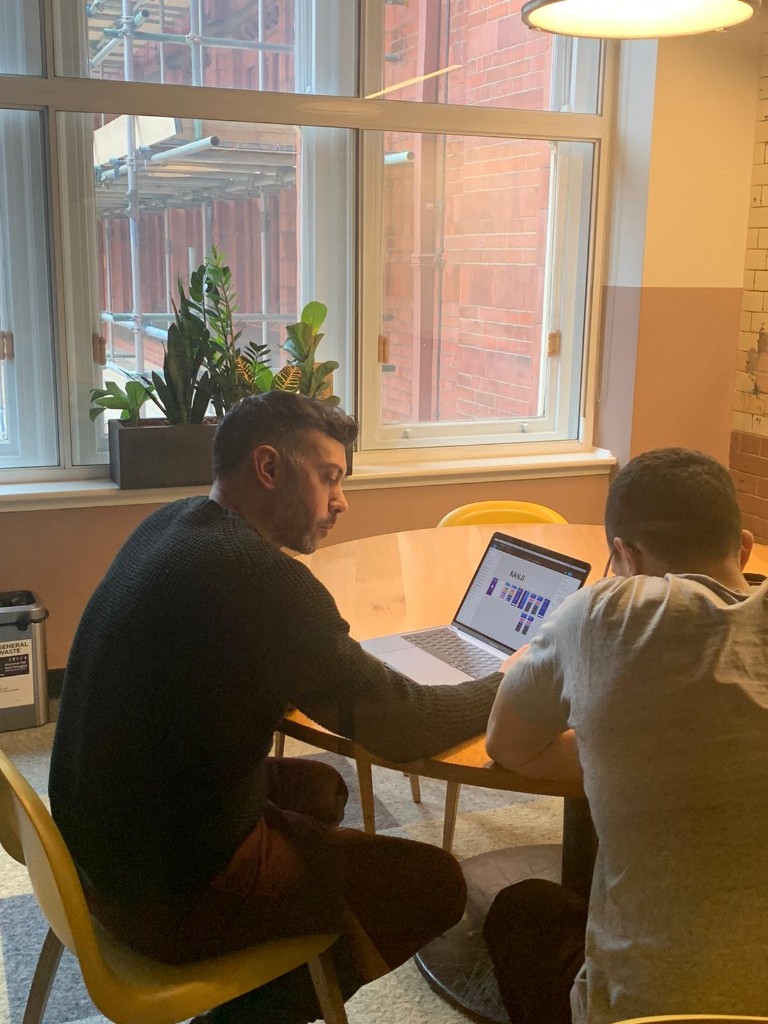
To design the writing feature, I first needed to understand how Japanese characters are traditionally learned. I studied Genki and beginner learning methods to understand how Hiragana and Katakana are introduced through character groups, repetition, stroke order and recall.
I studied how children learn hiragana and katakana — character sets, stroke order, tracing, repetition, recognition and the gradual removal of guidance — and translated those principles into a mobile learning model.

| Research principle | Design response |
|---|---|
| Characters are learned in structured groups | Organised practice into character sets |
| Stroke order is fundamental | Animated each stroke in sequence |
| Beginners require physical guidance | Introduced tracing paths and start/end markers |
| Support should reduce as competence grows | Removed guidance progressively across three levels |
| Recall consolidates learning | Added a quiz after each character group |
04 Learning model
Progressive support from tracing to recall.
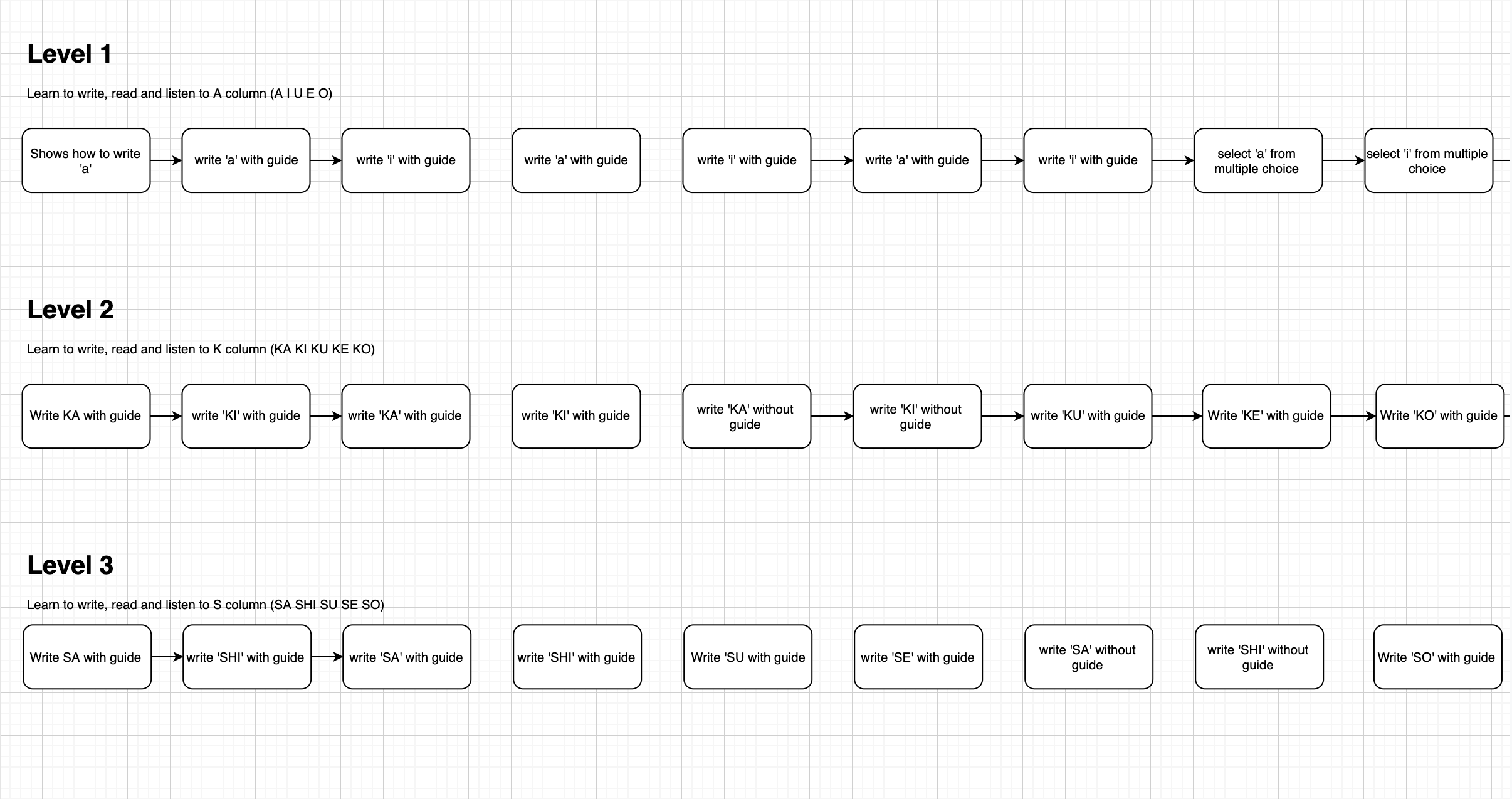
The goal was not simply to show users a character. It was to help them understand how each character is formed, practise the movement and then recall it later without support. I broke the learning journey into character sets, starting with the first Hiragana group: A, I, U, E, O.
Level 1
Full tracing guidance
Dashed path, start/end markers and animated stroke order for vowel-column characters.
Level 2
Reduced visual guidance
Dashed path removed; markers remain for K-column and S-column families.
Level 3
Independent recall
Guidance removed, reinforced through short recognition checks and final quiz.
05 Interface
Translating a physical learning method into a digital experience.
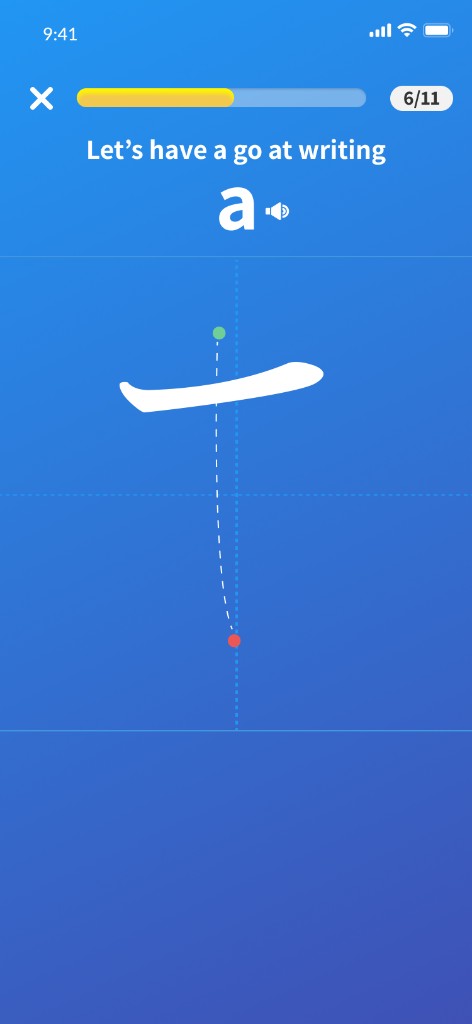
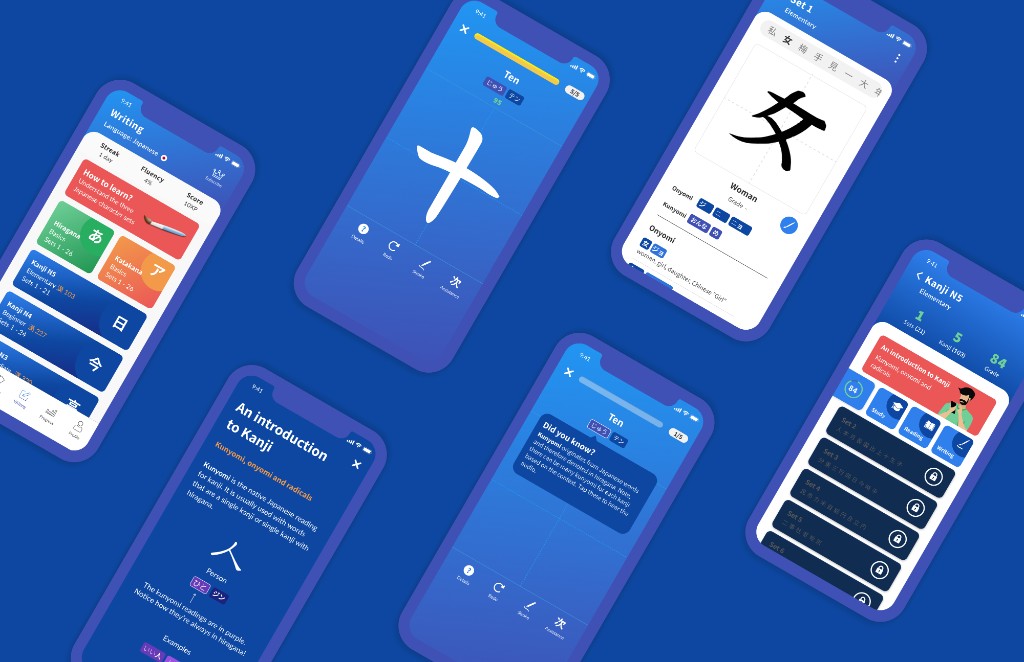
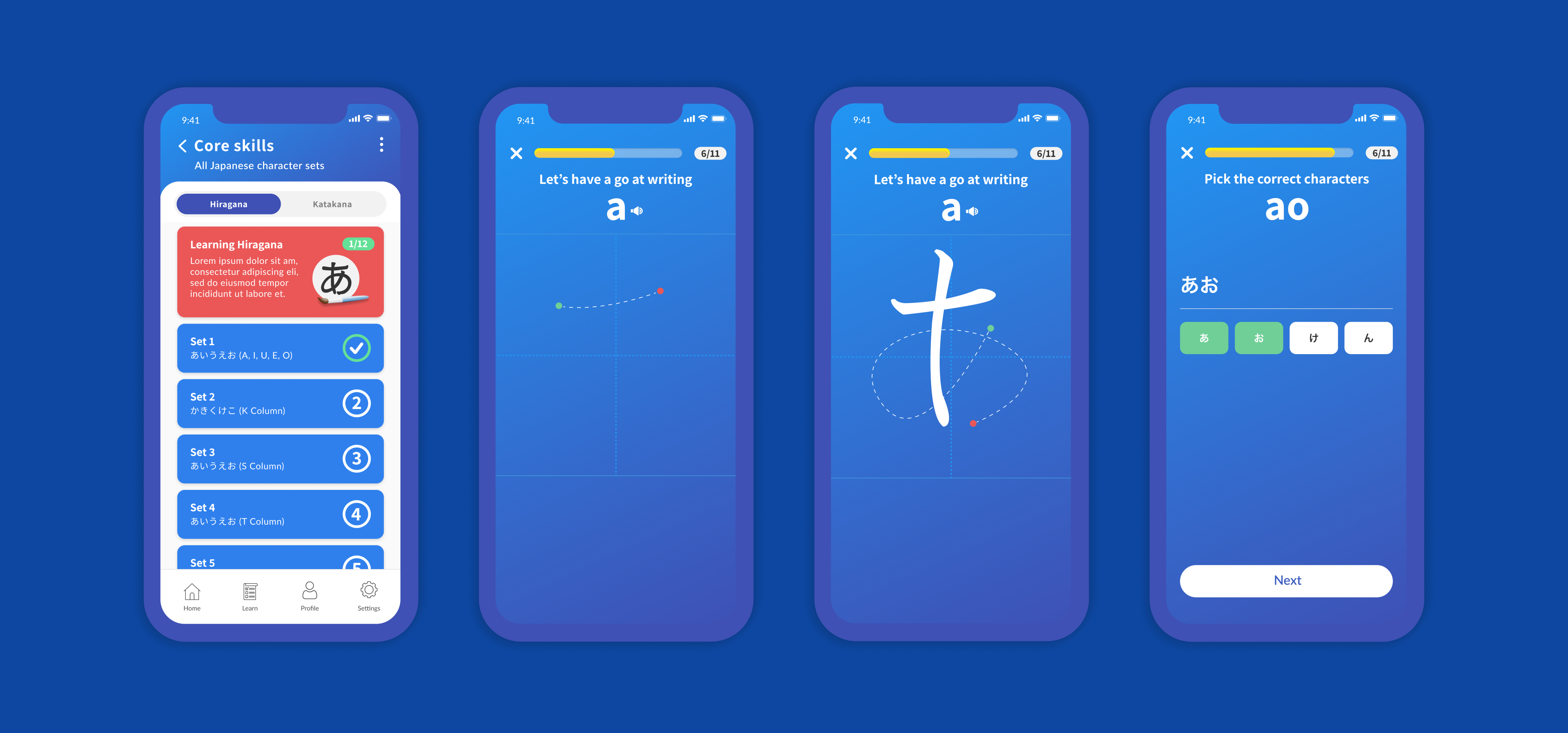
Each stroke used a green start point and a red end point to guide the user. The dashed line showed the correct stroke path at the easiest level. As the user progressed, the help was gradually removed so they could build confidence and memory.
At the end of each character set, users completed a short quiz combining characters they had learned. For example, after learning A, I, U, E, O, users were shown AO, meaning blue in Japanese — helping users feel that the writing exercise had practical value beyond isolated character practice.
06 Validation
Testing and delivery
I worked closely with language specialists to define the character sets, pronunciation and quiz logic. I also collaborated with developers to understand the technical constraints of stroke recognition, including the acceptable drawing area, stroke size and preventing users from completing the interaction by drawing outside the required path.
- 62% NPS in testing.
- Learners remained engaged with the tracing mechanic.
- Learners recalled the majority of characters during the final quiz. In testing, users were highly engaged with the writing mechanic and were able to recall the majority of characters during the final quiz.
The writing feature shifted the experience from passive learning into active practice, giving beginners a clearer sense of progress and achievement.
07 Results and learning
Foundations before advanced progression.
The strategic value was not simply adding handwriting. The writing system strengthened the beginner foundation, giving learners a structured path from recognition to active recall.
Testing showed strong engagement with the mechanic and solid recall in the final quiz, validating the decision to prioritise foundations over more advanced lesson content.
Guided writing helped learners acquire new characters, but they also needed a way to revisit vocabulary and grammar after a lesson ended.
Continue to Practice and flashcards