
04 of 06 · Retention support
Building a personalised practice system.
I designed a practice system that connected lesson history, confidence signals and revision into a personalised loop beyond individual conversation lessons.

At a glance
- Problem
- Learners could complete lessons but had no clear way to identify and revisit the vocabulary or grammar that needed further practice.
- Key insight
- Revision was more useful when it reflected material already encountered and showed where confidence was weakest.
- Decision
- Connect lesson history, confidence signals, vocabulary and grammar into a personalised practice system rather than a generic flashcard library.
- Result
- Established a connected practice model that turned completed lesson content into structured revision and a foundation for future personalisation.
01 Problem
The gap after lesson completion.
Learners could finish a conversation lesson but lacked a simple way to identify which vocabulary and grammar still required attention. Lesson completion alone did not guarantee retention — they needed a route back into difficult material without repeating entire lessons.
02 Practice model
From lesson activity to personalised revision.
The central loop connected what happened in lessons with independent practice:
Lesson activity → confidence or difficulty signal → material organised for revision → personalised practice → return to conversation.
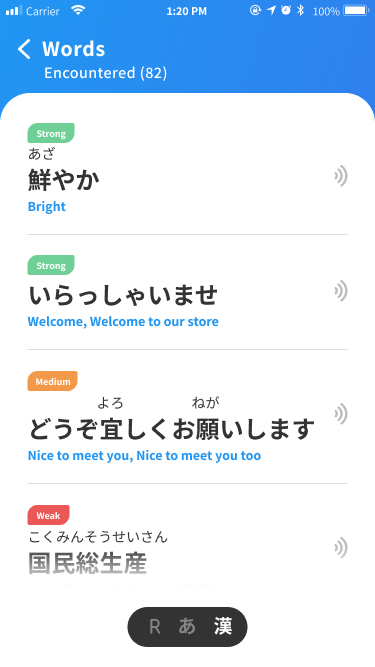
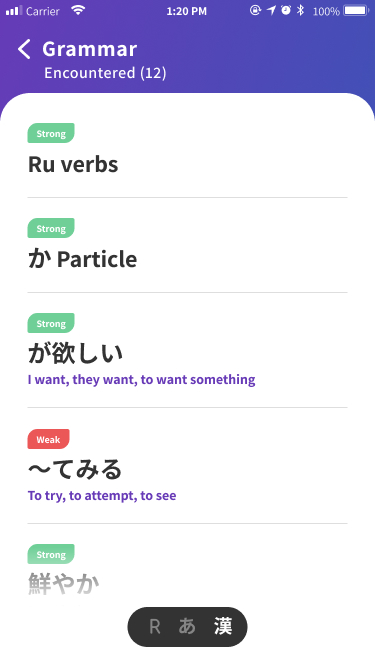
- Vocabulary and grammar encountered in completed lessons
- Confidence indicators and incorrect or difficult material
- Lesson history informing what to revisit
- Learner-selected revision alongside recommendations
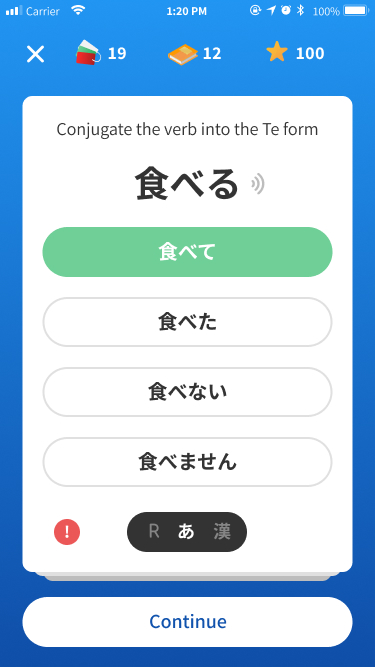
- Audio replay, recognition and recall exercises
03 Key decision
Confidence over chronology
Practice was organised around where learners felt least confident, not only the order lessons were completed. This made revision feel relevant rather than generic.
Decision and trade-off
- Alternative
- Generic flashcard library organised by topic or chronology alone.
- Chosen direction
- Personalised practice connected to lesson history and confidence signals.
- Evidence or constraint
- Revision was more useful when it reflected material already encountered and showed where confidence was weakest.
- Consequence
- A connected loop from lesson activity to targeted revision and back to conversation.
04 Exercises
Words, grammar and progress feedback.
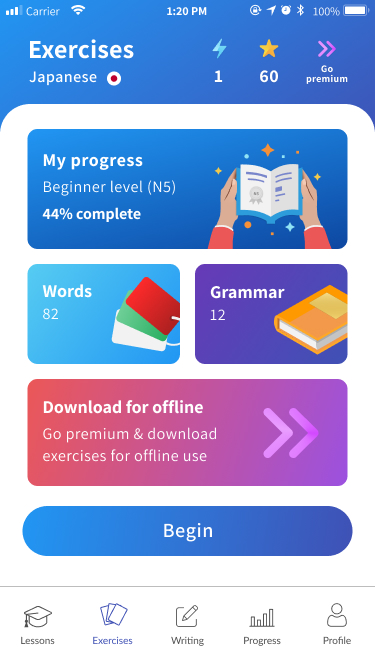
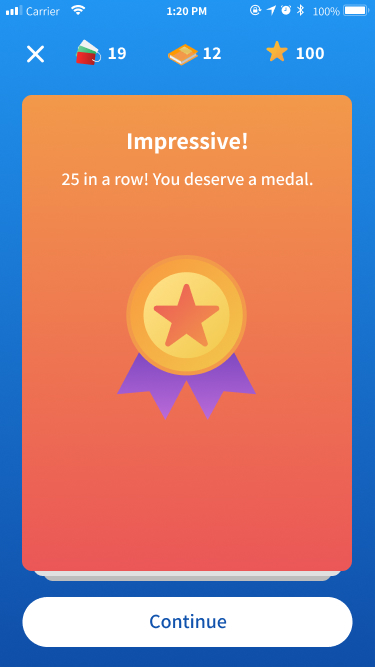
Each screen demonstrates a different part of the loop — entry point, vocabulary organisation, grammar lists and exercise interaction.
05 Delivery status
Shipped foundation, room to personalise further
Core practice flows — vocabulary and grammar exercises, lesson history and confidence markers — were designed and shipped. Deeper personalisation logic was established as a foundation for later development rather than a fully measured retention system.
06 Results and learning
Revision connected to real lesson history.
The practice layer connected lesson content with independent revision, giving learners a clearer route back into difficult vocabulary and grammar.
Future measurement should focus on repeat practice usage, return to lesson behaviour and whether revision improves previously difficult material.
Personalised practice supported progression between lessons. The next challenge was creating a repeatable habit that encouraged learners to return consistently.
Continue to Gamification and retention