
2.5×
Customers using lists spent up to 2.5× more than those who did not
01 Case Study
Turning messy shopping intent into intelligent baskets
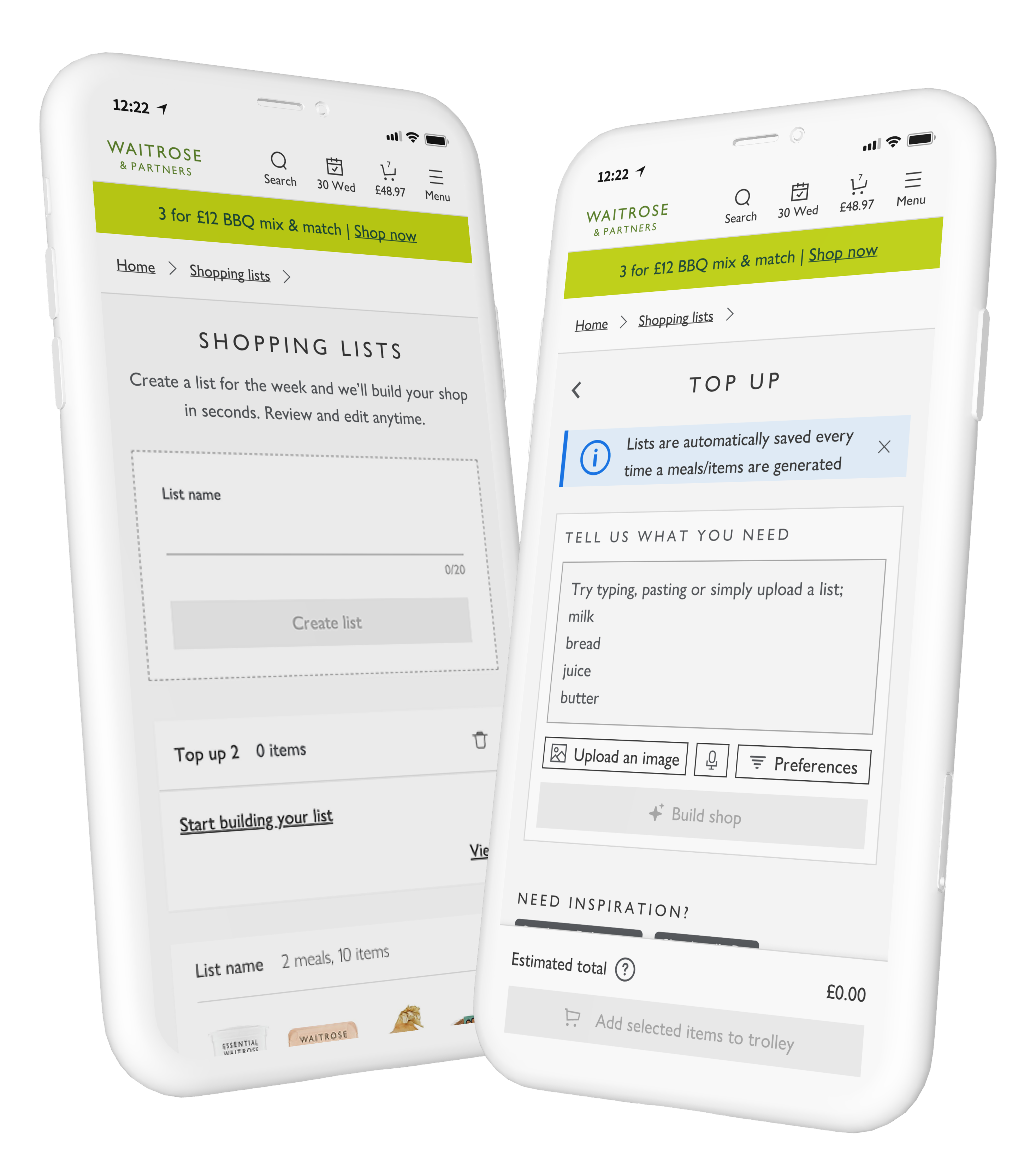

I led the experience strategy, interaction design, prototyping and validation approach, working across customer behaviour, data logic and basket-building flows.
02 Why this mattered
Shopping lists were one of the strongest behavioural signals linked to larger basket sizes and repeat purchasing, but existing list experiences still relied heavily on manual product searching and repetitive basket building.
2.5×
Customers using lists spent up to 2.5× more than those who did not
65%+
of customers still created physical lists
56%
used hybrid planning behaviour, combining meals and individual items
New online grocery customers often started with incomplete or ambiguous intent
03 The behaviour existed, but the habit was weak
Customers were already using lists, but the data showed that most were not building a repeatable list habit. The opportunity was not simply helping customers add items from lists to trolley. It was helping more customers create, reuse and mature their lists into a faster way to build a shop.
373k+
Saved shopping lists
Existing list behaviour was already present across the customer base.
252k+
Customers
A meaningful number of customers had created at least one saved list.
80%
Had only one list
Most list users had not yet developed a repeatable list habit.
0.5%
Added lists to trolley
Very few saved lists were being converted into basket-building behaviour.
The issue was not whether customers understood lists. They already did. The bigger opportunity was to improve list creation, reuse and conversion into trolley-building behaviour, especially for customers who planned their shop before entering the grocery journey.
04 Why list maturity mattered commercially
List users showed stronger commercial behaviour, with higher order frequency, higher average order value and higher-value trolleys. That made list creation and reuse a strategic growth opportunity, not just a usability improvement.
72%
Higher order frequency
List users ordered more often than non-list users.
36%
Higher average order value
List users generated stronger average order value.
£417.03 vs £177.52
Net cart revenue
List users showed materially higher trolley value than non-list users.
£22.46 vs £16.42
Average value per shop
A £6.35 uplift per shop showed the value of increasing list usage.
The objective was to move more customers from single-list behaviour into repeat list usage, increase list-to-trolley conversion, and support competitor win-back by making Waitrose faster and easier for planned shops.
Move more single-list customers towards two or more reusable lists.
Turn saved planning behaviour into basket-building behaviour.
Reduce the friction for customers bringing existing planning habits from competitors.
Increase exposure to a behaviour already linked with higher frequency and higher order value.
The opportunity connected a £150m Ocado win-back ambition with a £400m existing-shopper spend opportunity.
05 The problem
Customers rarely think in exact product titles or SKUs. Instead, they create fragmented reminders throughout the week: handwritten notes, screenshots, meals, family requests, generic reminders and brand references. Traditional grocery experiences forced customers to manually translate this intent into products one item at a time.
Customers translated messy list items into products one at a time before they could start shopping.
Too many possible matches for vague inputs made planning feel harder than it needed to be.
The same items and brands were searched again each week instead of reusing existing intent.
Customers hesitated when they could not see, review or correct suggestions before adding to basket.
Less purchase history meant more guesswork and more manual work to build a first online basket.
06 From search-and-select to prediction-first
Traditional grocery search asks customers to translate intent into individual product decisions. For a weekly shop, that creates repeated effort: search, compare, select, adjust and repeat. A prediction-first model changes the sequence. The customer starts with intent, and the system generates a draft trolley using behavioural signals that can be reviewed and edited.
The goal was not full automation. It was to reduce the effort between intent and trolley while keeping confidence high.
07 Product gap
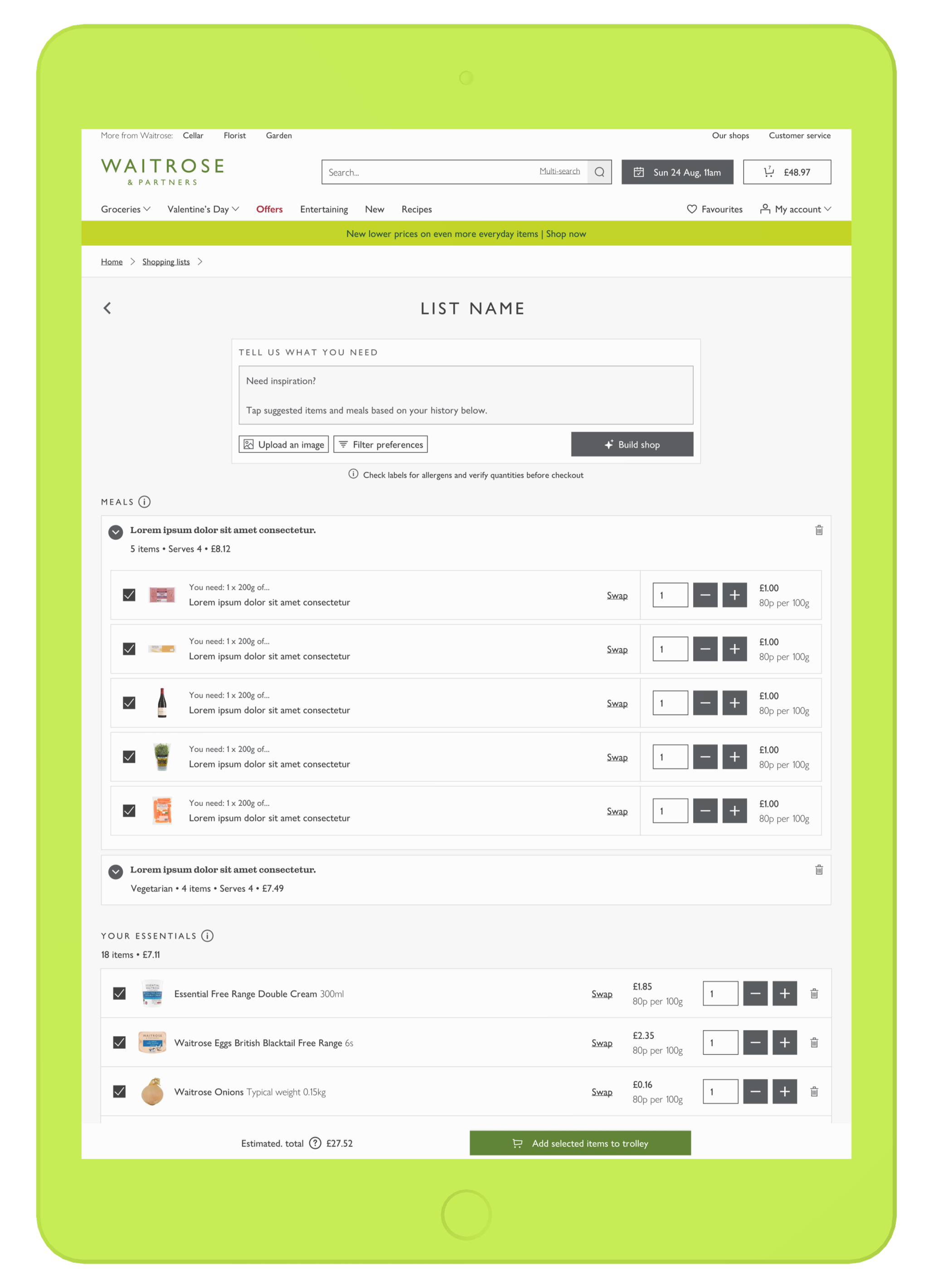
The current lists experience was fragmented across app and web. The app did not support saved lists, while web lists were tied to specific products. Multi-search behaved more like a temporary output than something customers could save, reuse or build on.
The opportunity was to move from temporary search outputs and fixed product lists towards reusable, intelligent product groupings across platforms.
No saved lists. Multi-search behaved like a temporary output.
Saved product lists, but tied to specific products.
Reusable, intelligent product groupings across app and web.
How could we help customers move from intent to basket faster without removing confidence or control?
08 Design principles
These principles shaped how the experience balanced prediction, trust and customer ownership.
Let customers begin with how they naturally plan: typed lists, notes, meal ideas, screenshots or saved lists.
Use behavioural signals to suggest likely products before asking customers to search item by item.
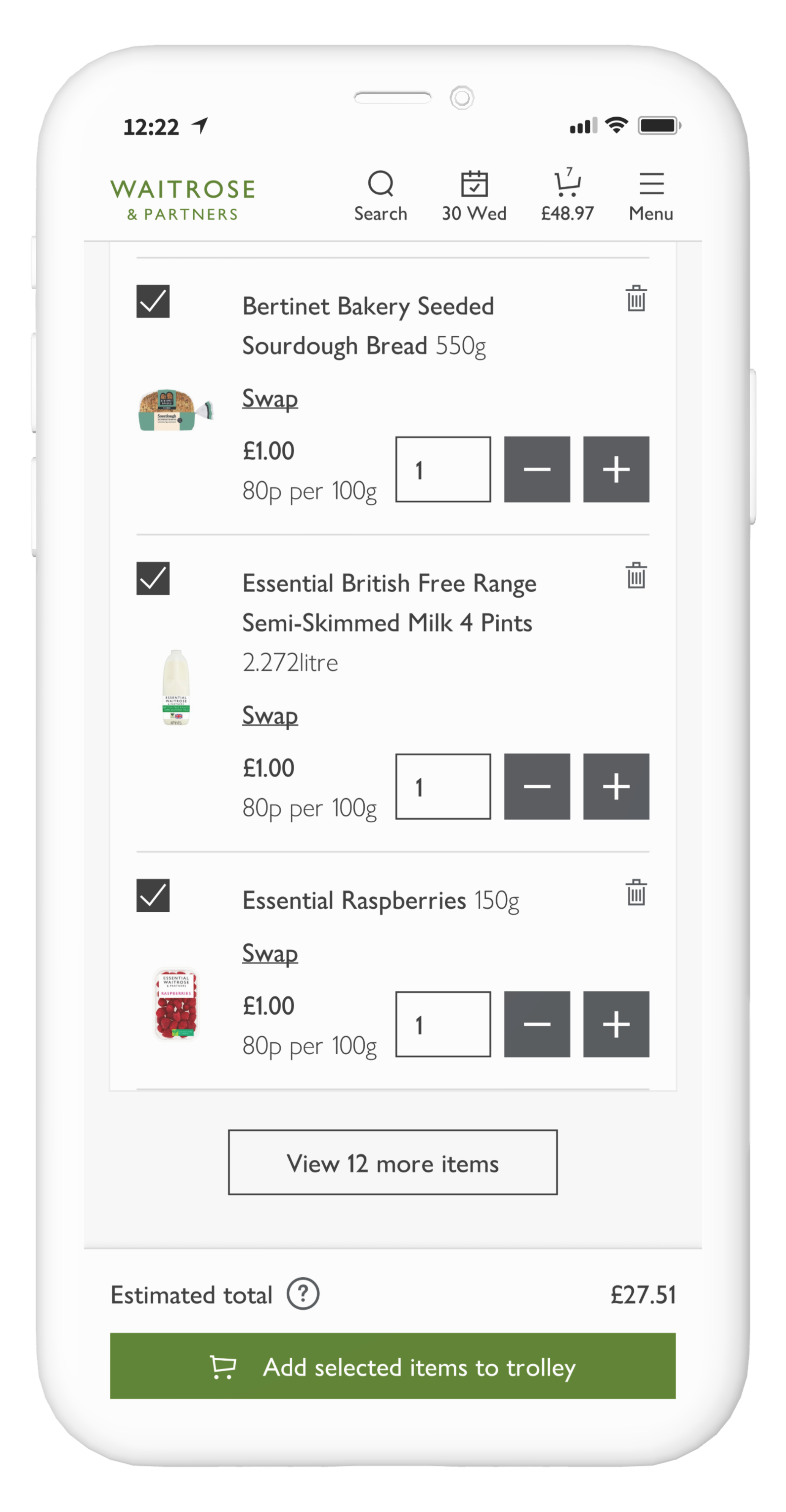
Suggestions must stay editable, swappable and removable before anything is added to trolley.
Make it clear what the system has recognised, where it is confident and where review is needed.
Use customer corrections as signals without over-interpreting temporary decisions or one-off changes.
The challenge was not matching products. It was recommending with confidence.
09 Intent-to-product mapping
Prediction-first only worked if the system could translate vague customer inputs into specific, reviewable products. The design challenge was deciding what the system should infer, when it should use customer history, and where customers needed control.
“milk”, “bread”, “pasta”, “snacks” or uploads a handwritten list.
Favourites, purchase history, preferences, brand/range, price sensitivity and popular products.
A likely product, likely quantity and alternatives where confidence is lower.
Swap, remove, adjust quantity and review before adding to trolley.
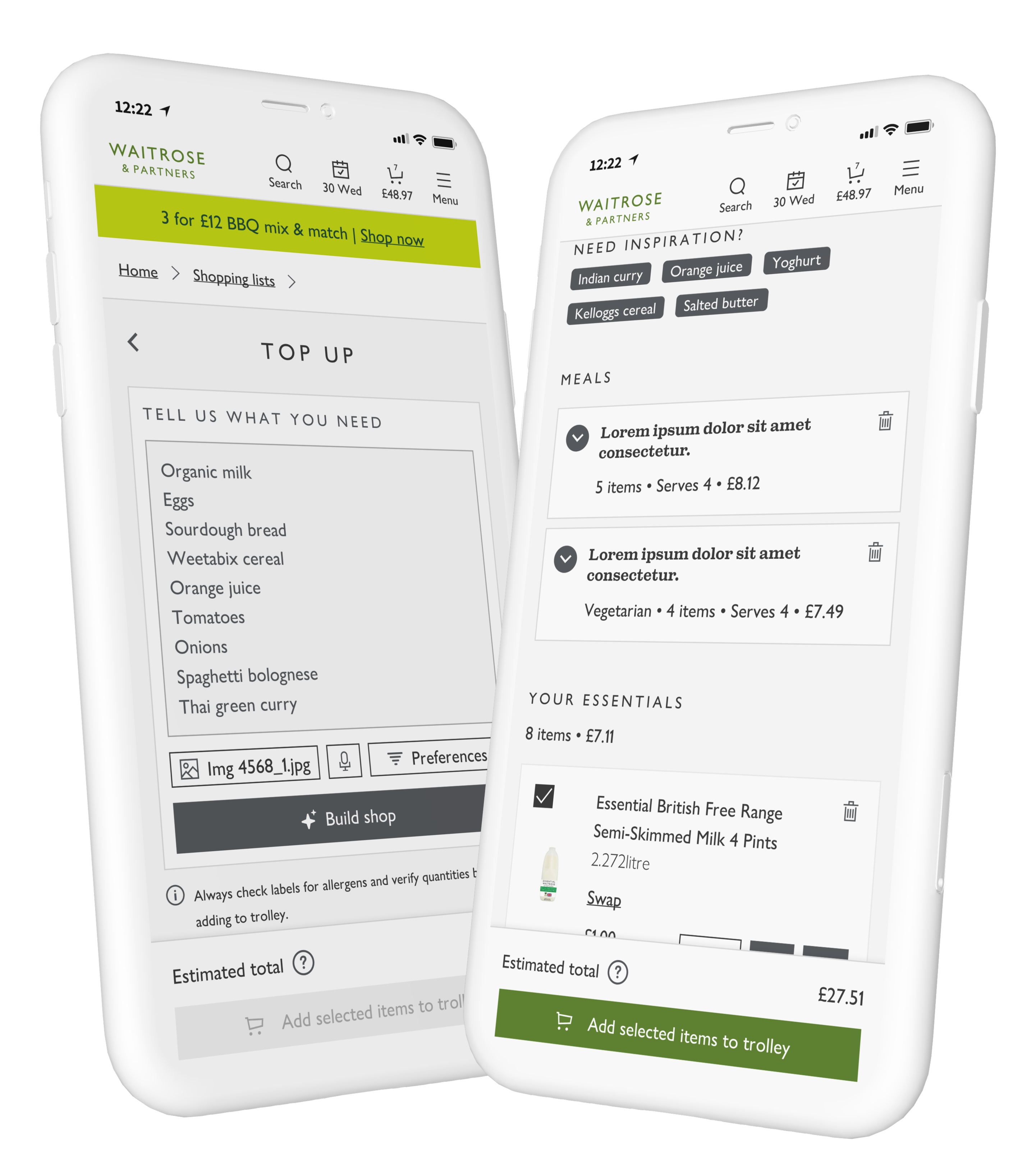
The output needed to mirror the input closely enough for customers to recognise what had been interpreted, compare it quickly and correct anything that felt wrong.
10 MVP scope and trade-offs
The MVP needed to prove whether real-world shopping intent could be converted into basket-ready products without adding unnecessary complexity.
Voice was useful long term, but not essential to prove the core intent-to-basket loop. It also risked making the experience feel like a conversational assistant, which added complexity and raised the wrong expectations.
Instead of making customers search for every item, the system interpreted shopping intent first and generated a draft trolley customers could review, swap and adjust.
Personalisation depended on favourites, previous orders and shopping behaviour, so signed-in customers gave the system stronger signals for product mapping. Newer customers could still be supported after account creation through popular products and lightweight preferences.
Ambiguous list inputs
Physical lists were often vague, making accurate product interpretation difficult.
Unreliable OCR
Confidence varied with handwriting, formatting and image clarity.
Operational complexity
Availability, substitutions and category logic added backend complexity.
11 Feedback loop
Every customer correction can become a signal, but not every correction means the same thing. The system needed to learn carefully from edits, swaps, removals and quantity changes.
Removes oat milk
Learns: Negative preference signal
Future: Suggest it less often
Swaps branded cereal for own-label
Learns: Price sensitivity
Future: Prioritise value alternatives
Increases pasta quantity
Learns: Household size signal
Future: Adjust future quantities
Keeps recipe ingredients
Learns: Meal interest signal
Future: Suggest similar meals
Unchecks an item
Learns: May already have it at home
Future: Do not treat as dislike
The system should learn from behaviour, but avoid over-interpreting temporary shopping decisions.
12 Validation and iteration
We tested early concepts with customers, then refined around clarity, trust and control.
5
Moderated tests
5
Unmoderated tests
6/7
Ease of Use rating
Testing validated behaviour, trust and interaction patterns, not production-level OCR accuracy or recommendation performance.
The next stage was not about adding more features. It was about improving accuracy, language and trust so customers felt confident using the experience repeatedly.
The real breakthrough was not automation. It was editable intelligence.
13 Impact and outcomes
The concept connected an existing high-value behaviour with a faster way to create, reuse and convert lists into trolleys.
Customers could move from a note, meal idea, saved list or handwritten shop into editable product suggestions faster.
The experience reduced reliance on item-by-item search by generating a draft trolley first, then letting customers review and refine.
The strategy targeted customers who had only one list, helping them create and reuse multiple shopping missions over time.
The opportunity was to turn saved planning behaviour into actual basket-building behaviour, addressing the very low list-to-trolley conversion baseline.
List usage was already associated with higher order frequency, higher average order value and stronger trolley value.
A faster intent-to-trolley experience could help customers bringing established planning habits from Ocado or other grocery competitors.
14 Closing thought
We were not designing a shopping list. We were designing a system that removed effort from turning intent into a shop, then helped customers reuse that intent again and again.
The value was not just faster basket building. It was turning real-life planning behaviour into a reusable, personalised shopping system.
View prototype